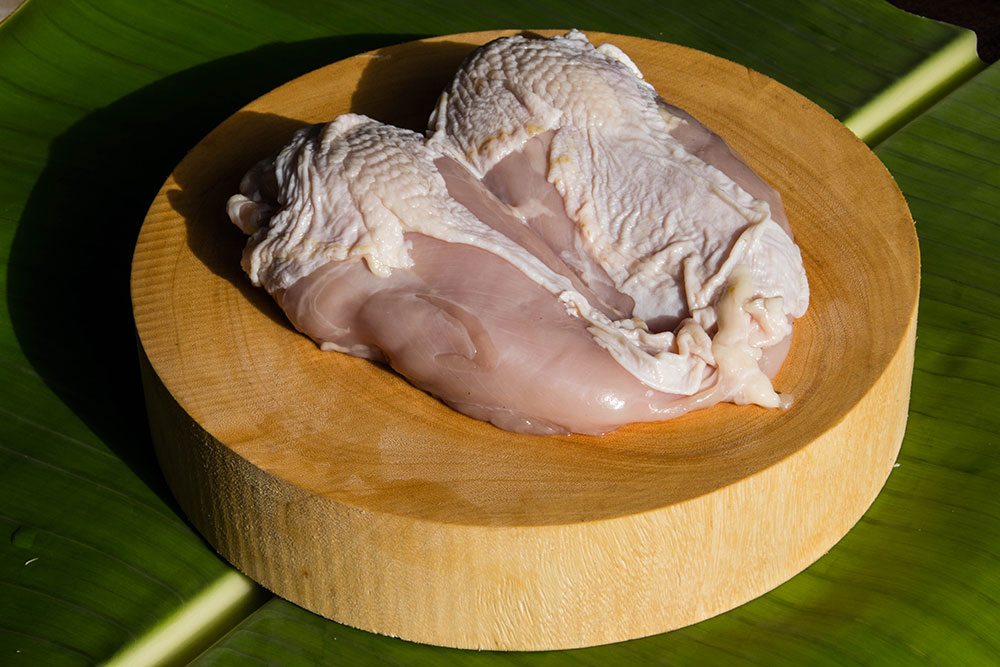
Chicken breast
The earliest known domesticated Chicken dates back to 8500 BCE.
We know that from archaeological finds of chicken bones in northern China. In the fifth century, the chicken spread throughout Asia to India.
So we can then safely assume that Chicken breast has been a part of the diet since then.
Then the domesticated chicken was imported to Greece. from there it spread to the rest of Europe.
The annual chicken production in 2009 was estimated at 50 billion chickens. 7 billion was raised in China, 9 billion in the USA and 6 billion in the European Union.
Chickens are very social, and the rooster is a real gentleman. When he finds food he calls the other chickens in the flock to eat first. He does that by continuously picking up dropping the food while he calls for the others attention by clicking in a high pitch.
Hens have a very social approach to raising the young and incubation of eggs. They will often try to find a nest already containing eggs, sometimes they also move eggs from another nest into their own nest.
This is because the hens prefer to have only a few locations for nests instead of every bird have its own nest. Two or more hens can even share the same nest at the same time.
This behavior makes sure that there is always somebody at “home” to take care of the eggs.
The nutrient fact, below, is based on 100 gram of raw Chicken, broiler or fryers, breast, skinless, boneless, meat only, cooked, grilled.
Vitamins
Vitamin C, total ascorbic acid mg 0
Thiamin mg 0.107
Riboflavin mg 0.213
Niacin mg 12.133
Vitamin B-6 mg 1.157
Vitamin B-12 µg 0.21
Vitamin A, RAE µg 10
Vitamin A, IU IU 32
Vitamin E (alpha-tocopherol) mg 0.54
Vitamin D (D2 + D3) µg 0
Vitamin D IU 1
Vitamin K (phylloquinone) µg 0
Lipids
Fatty acids, total saturated g 0.992
Fatty acids, total monounsaturated g 1.212
Fatty acids, total polyunsaturated g 0.764
Fatty acids, total trans g 0.01
Cholesterol mg 104
Proximates
Water g 66.14
Energy kcal 151
Protein g 30.54
Total lipid (fat) g 3.17
Carbohydrate, by difference g 0
Fiber, total dietary g 0
Sugars, total g 0
Minerals
Calcium, Ca mg 5
Iron, Fe mg 0.45
Magnesium, Mg mg 34
Phosphorus, P mg 258
Potassium, K mg 391
Sodium, Na mg 52
Zinc, Zn mg 0.9