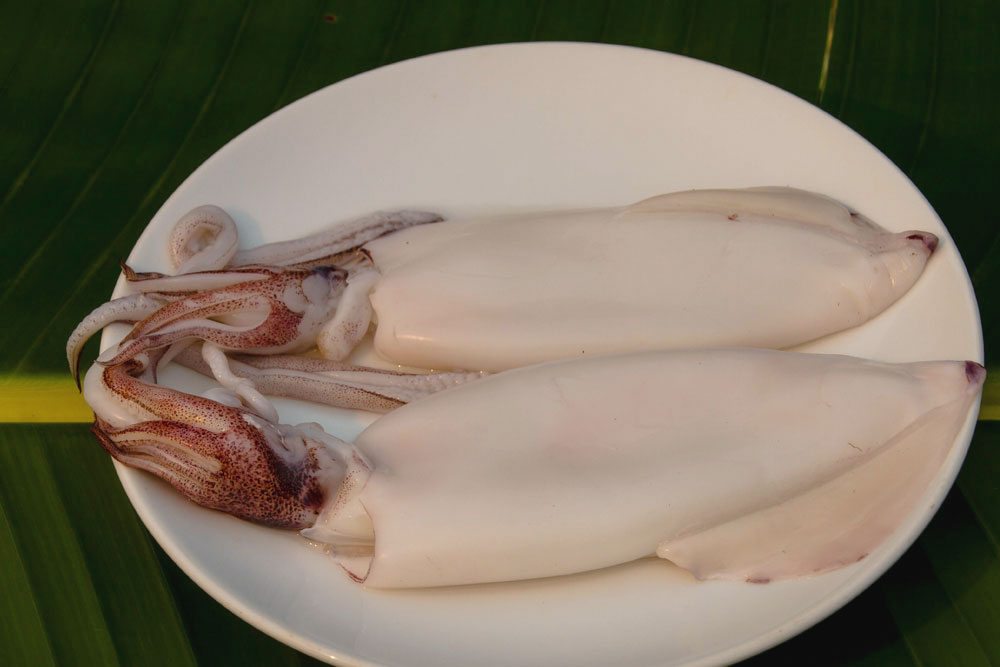
Squid
A Squid only has head and feet, but it has 3 harts.
A squid belongs to the Cephalopods. Until now, there have been discovered more, than 300 different species of squid.
An ancestor of today’s squid is known to have lived about 550 million years ago.
The biggest type of squids can grow to a size of 18 meters and 450 kilos. The smallest one is the sepiolid squid. It is less than 2,50 centimeter long and its weight is about 7 gram. The average size of the normal type of squids is around 50-60 centimeter.
Some types of squids live as far down in the ocean at 4.000 meters. Many of the spices have a life span up to, about one year only.
Squids move backward, feet first. They can reach speeds of up to 25 miles per hour in spurts.
The squids have a very large brain they are considered very intelligent. The nerves in their brains are also thicker than any nerves in the human brain.
This is particularly true for the species Loligo Pealei. Therefore practice some brain surgeons surgical techniques on this Squid, as it is easier to start with before they start operating humans.
The hormones are found L-Dopa and Dopamine, in the ink of some types of squids. Those two hormones are happy hormones, our body produces them to make us feel happy.
That these two hormones are in squid ink, give the Italian dish “squid in its own ink” something to think about. I do not know how much squid ink you have to eat or how it works, but i find it a little funny.
The nutrient fact, below, is based on 100 gram of raw squid, mixed species.
Vitamins
Vitamin C, total ascorbic acid mg 4.7
Thiamin mg 0.02
Riboflavin mg 0.412
Niacin mg 2.175
Vitamin B-6 mg 0.056
Folate, DFE µg 5
Vitamin B-12 µg 1.3
Vitamin A, RAE µg 10
Vitamin A, IU IU 33
Vitamin E (alpha-tocopherol) mg 1.2
Vitamin D (D2 + D3) µg 0
Vitamin D IU 0
Vitamin K (phylloquinone) µg 0
Lipids
Fatty acids, total saturated g 0.358
Fatty acids, total monounsaturated g 0.107
Fatty acids, total polyunsaturated g 0.524
Cholesterol mg 233
Proximates
Water g 78.55
Energy kcal 92
Protein g 15.58
Total lipid (fat) g 1.38
Carbohydrate, by difference g 3.08
Fiber, total dietary g 0
Sugars, total g 0
Minerals
Calcium, Ca mg 32
Iron, Fe mg 0.68
Magnesium, Mg mg 33
Phosphorus, P mg 221
Potassium, K mg 246
Sodium, Na mg 44
Zinc, Zn mg 1.53