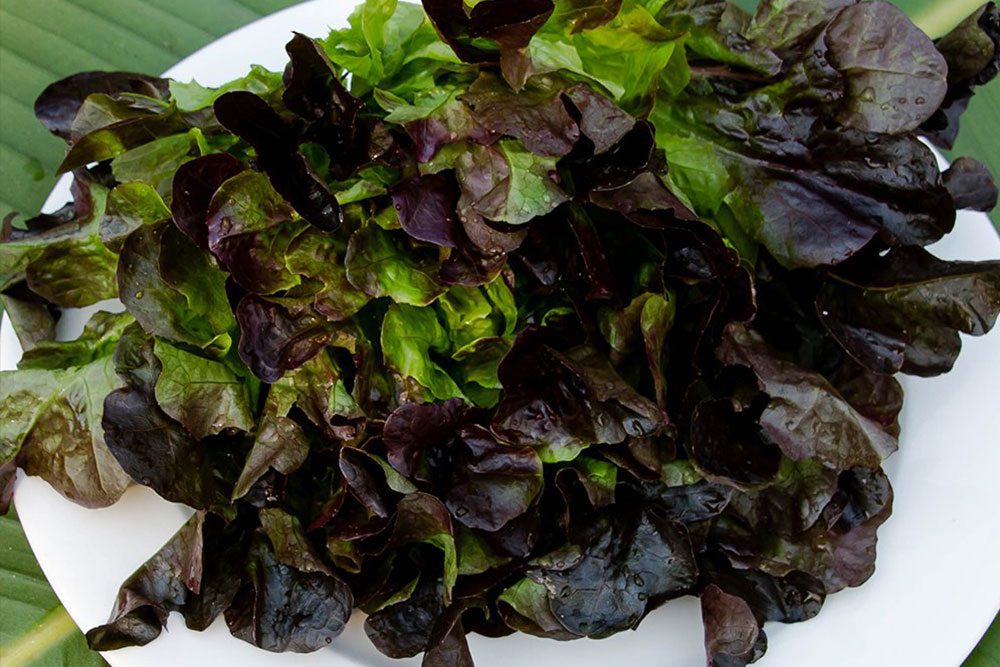
Red Leaf Lettuce
Red leaf lettuce is the red variant of one of the 6 subspecies of lettuce.
The cultivation of lettuce dates back to the Egyptians 4500 years ago. Lettuce is properly derived from wild weed and through careful breeding, we have the hundreds of lettuce we know today.
The farmers have though selection, being able to broaden the leaves and get a sweeter taste instead of the more bitter taste of the wild weed. There are still being developed new varieties of lettuce today. A farmer always tries to perfect his products. When farmer develops a new variety have the right to give it a name.
There was consumed a lot of lettuce in ancient Greece, and already they breed a lot of different varieties. It was the Romans who spread lettuce throughout Europe.
Red Leaf lettuces are popular to use in cooking because of their beautiful colors.
It also contains Anthocyanins, it is a pigment found in all red colored food plants. This pigment is antioxidant flavonoids. The flavonoids protect many of our body systems.
The nutrient fact, below, is based on 100 gram of raw red leaf Lettuce.
Vitamins
Vitamin C, total ascorbic acid mg 3.7
Thiamin mg 0.064
Riboflavin mg 0.077
Niacin mg 0.321
Vitamin B-6 mg 0.1
Folate, DFE µg 36
Vitamin B-12 µg 0
Vitamin A, RAE µg 375
Vitamin A, IU IU 7492
Vitamin E (alpha-tocopherol) mg 0.15
Vitamin D (D2 + D3) µg 0
Vitamin D IU 0
Vitamin K (phylloquinone) µg 140.3
Lipids
Fatty acids, total saturated g 0.017
Fatty acids, total monounsaturated g 0.005
Fatty acids, total polyunsaturated g 0.072
Fatty acids, total trans g 0
Cholesterol mg 0
Proximates
Water g 95.64
Energy kcal 16
Protein g 1.33
Total lipid (fat) g 0.22
Carbohydrate, by difference g 2.26
Fiber, total dietary g 0.9
Sugars, total g 0.48
Minerals
Calcium, Ca mg 33
Iron, Fe mg 1.2
Magnesium, Mg mg 12
Phosphorus, P mg 28
Potassium, K mg 187
Sodium, Na mg 25
Zinc, Zn mg 0.2