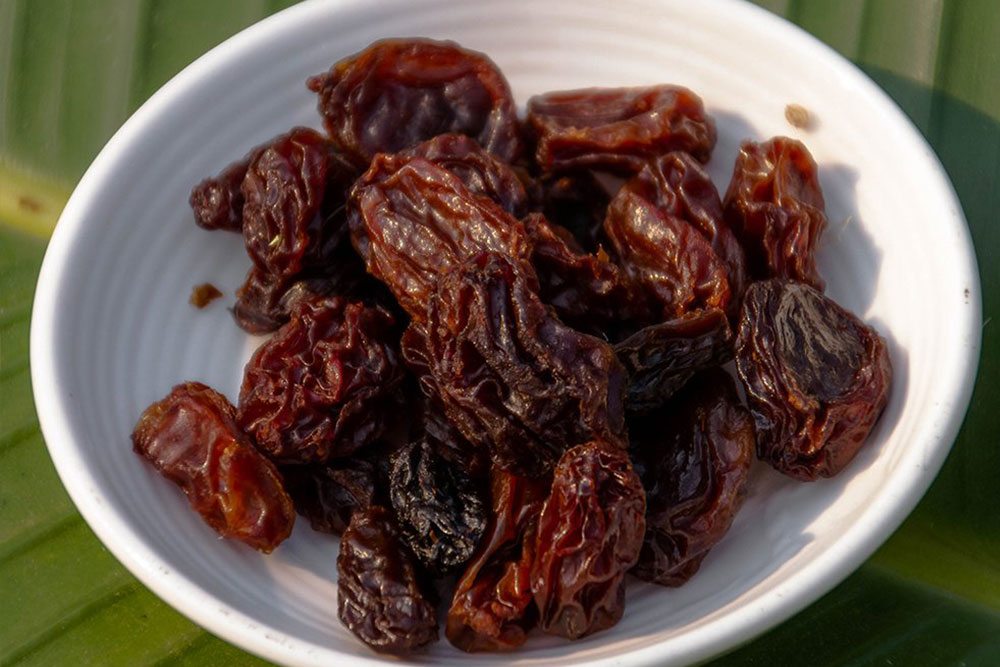
Raisins
There are many types of raisins.
The definition of raisins is that they are dried grapes. So all kind of dried grapes is raisins. And with more than 10,000 varieties of wine grapes in the world, there is a lot of different raisins. But you do not see 10.000 different kinds of raisins in your local supermarket. That is because only a few varieties are used for making raisins.
The earliest type of grape wine grown 35 million years ago, in what we now know as France. And as raisins are dried grapes it seems logical that there should be some grapes who dried out and became raisins. There is evidence for that grapevines have been in cultivation since 6500 BC.
We have all seen golden raisins, but the surprise is that they are made from the same varieties as are used for making the normal seedless raisins.
When the raisins still are grapes and still attached to the wine plant, they are all same green color, both those who will be normal raisins and the ones there will be golden raisins.
The color all depends on what treatment the grapes get to become raisins. Fresh Grape before they are made into raisins contains about 80% water, raisins contains about 15% water, so there is a lot of water there have to go out.
There are different ways to dry the raisins, the best way, for the consumer, is to sun dry them. Other methods include micro ovens and other not so nice things.
But to get the golden color, you have to bleach the raisins. The chemical used for bleaching is sulfur dioxide. To me, sulfur dioxide did not sound particularly healthy. So I Googled “sulfur dioxide health risks”, and you should do the same if you like golden raisins.
I will never eat golden raisins again, and I will also make sure my raisins are sun-dried in a natural healthy way.
The nutrient fact, below, is based on 100 gram of seedless Raisins.
Vitamins
Vitamin C, total ascorbic acid mg 2.3
Thiamin mg 0.106
Riboflavin mg 0.125
Niacin mg 0.766
Vitamin B-6 mg 0.174
Folate, DFE µg 5
Vitamin B-12 µg 0
Vitamin A, RAE µg 0
Vitamin A, IU IU 0
Vitamin E (alpha-tocopherol) mg 0.12
Vitamin D (D2 + D3) µg 0
Vitamin D IU 0
Vitamin K (phylloquinone) µg 3.5
Lipids
Fatty acids, total saturated g 0.058
Fatty acids, total monounsaturated g 0.051
Fatty acids, total polyunsaturated g 0.037
Fatty acids, total trans g 0
Cholesterol mg 0
Proximates
Water g 15.43
Energy kcal 299
Protein g 3.07
Total lipid (fat) g 0.46
Carbohydrate, by difference g 79.18
Fiber, total dietary g 3.7
Sugars, total g 59.19
Minerals
Calcium, Ca mg 50
Iron, Fe mg 1.88
Magnesium, Mg mg 32
Phosphorus, P mg 101
Potassium, K mg 749
Sodium, Na mg 11
Zinc, Zn mg 0.22