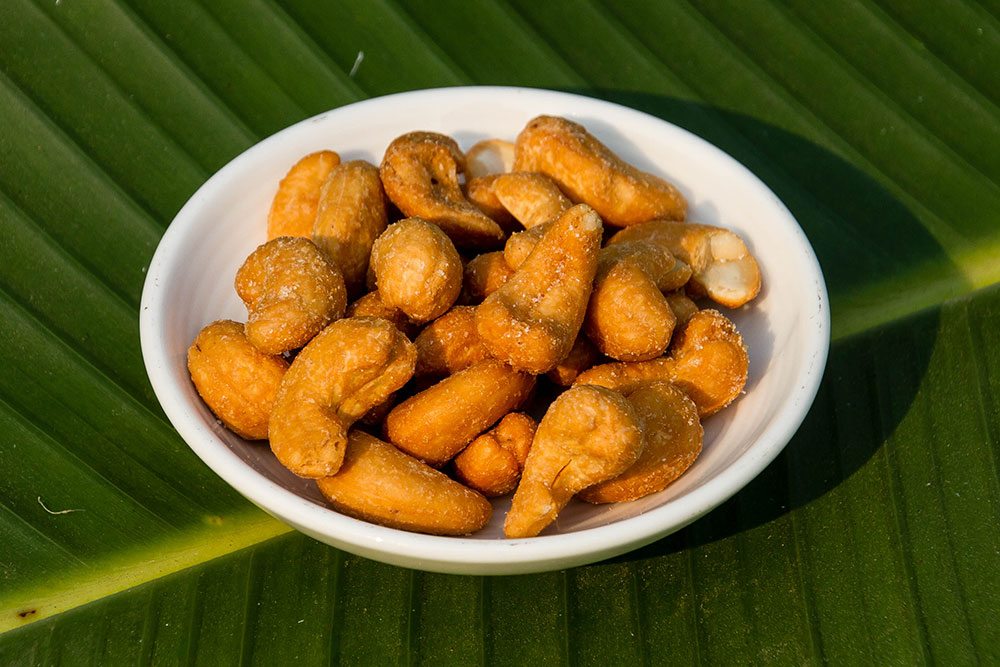
Cashew nuts
Cashew nuts are not nuts but seeds and comes from the cashew apple.
The shell of the cashew nuts or seeds is toxic, that is why they are never sold with the shell on but always peeled, you can say they are always unpacked.
Roasting the nuts will destroy the toxin. The roasting process must be done outdoors as the smoke is toxic as well.
The shell, however, has other uses. It can be used in many applications from paints to lubricants. Other parts of the cashew tree itself have been used in traditional natural medicine for snake bite and other things.
The cashew nuts are enjoyed almost all over the world. Some places it is used for making cashew cheese and some places it is made into cashew butter.
In Thai food, the cashew nuts are mostly used for fried dishes where they are mixed with the other ingredient.
In India, the juice is extracted from the cashew apple and made into a fruit juice. The juice is distilled into a liquor called Feni, which is about 40-42% alcohol.
The cashew tree is native to Brazil. Between 1560 and 1565, it was taken by the Portuguese to Goa in India. From there it spread through Asia, and later Africa.
The nutrient fact, below, is based on 100 gram of Cashew nuts, dry roasted, without salt added.
Vitamins
Vitamin C, total ascorbic acid mg 0
Thiamin mg 0.2
Riboflavin mg 0.2
Niacin mg 1.4
Vitamin B-6 mg 0.256
Folate, DFE µg 69
Vitamin B-12 µg 0
Vitamin A, RAE µg 0
Vitamin A, IU IU 0
Vitamin E (alpha-tocopherol) mg 0.92
Vitamin D (D2 + D3) µg 0
Vitamin D IU 0
Vitamin K (phylloquinone) µg 34.7
Lipids
Fatty acids, total saturated g 9.157
Fatty acids, total monounsaturated g 27.317
Fatty acids, total polyunsaturated g 7.836
Cholesterol mg 0
Proximates
Water g 1.7
Energy kcal 574
Protein g 15.31
Total lipid (fat) g 46.35
Carbohydrate, by difference g 32.69
Fiber, total dietary g 3
Sugars, total g 5.01
Minerals
Calcium, Ca mg 45
Iron, Fe mg 6
Magnesium, Mg mg 260
Phosphorus, P mg 490
Potassium, K mg 565
Sodium, Na mg 16
Zinc, Zn mg 5.6