Pineapple
Pineapple is not one fruit, but a cluster of coalesced berries.
 Many think that a pineapple is one fruit but it is not, it is actually many fruits grown together, called pineapples. The word pineapple come from pine. A pine cone look like a pineapple in the building while it is still sitting on the tree.
When the plant create the pineapple it normally can produce up to 200 small flowers, each will become a fruit. All the fruits will join together in what we know as a pineapple.
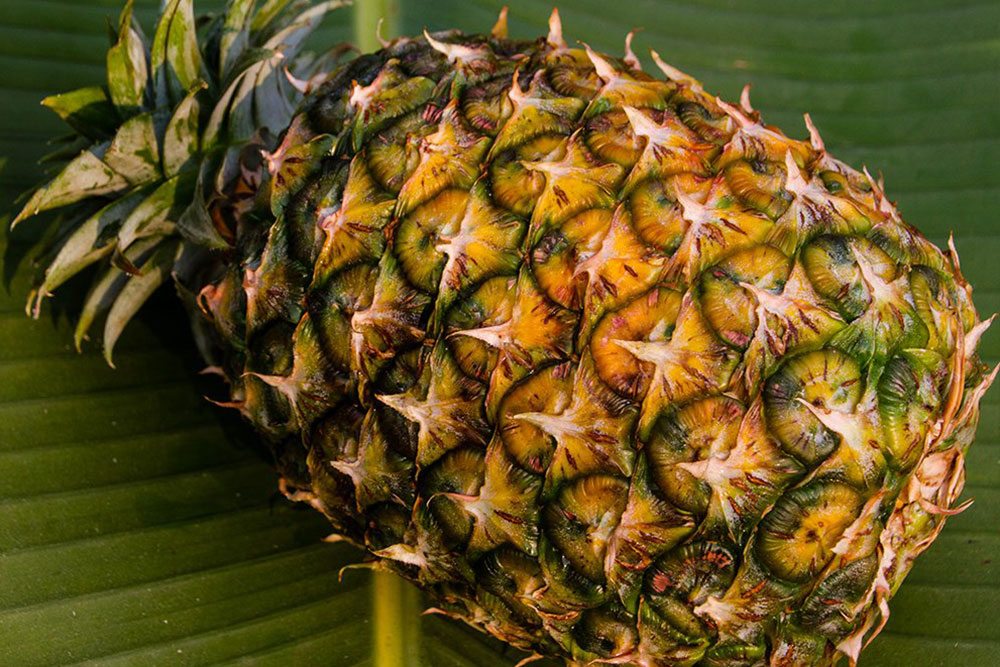
When you look at a grown pineapple you will see it is made of a lot of small squares. Each square is one fruit, first it have flowered and then it have become a fruit, joined together with all the other fruits. If you’ve seen a pineapple growing it is very easy and clear to follow what happens.
Pineapple is a tropical plant, and it is very easy to grow. When you cut the top of a pineapple in order to prepare it for eating, just cut so a little of the fruit meat it still attached to the top. Then place the top in the soil and you will get a new pineapple.
Pineapple is believed to be native to the area between Paraguay and southern Brazil. It was the Portuguese explorer who spread the pine apple to the rest of the world.

The nutrient fact, below, is based on 100 gram of all varieties of raw Pineapple.
Vitamins
Vitamin C, total ascorbic acid mg 47.8
Thiamin mg 0.079
Riboflavin mg 0.032
Niacin mg 0.5
Vitamin B-6 mg 0.112
Folate, DFE µg 18
Vitamin B-12 µg 0
Vitamin A, RAE µg 3
Vitamin A, IU IU 58
Vitamin E (alpha-tocopherol) mg 0.02
Vitamin D (D2 + D3) µg 0
Vitamin D IU 0
Vitamin K (phylloquinone) µg 0.7
Lipids
Fatty acids, total saturated g 0.009
Fatty acids, total monounsaturated g 0.013
Fatty acids, total polyunsaturated g 0.04
Fatty acids, total trans g 0
Cholesterol mg 0
Proximates
Water g 86
Energy kcal 50
Protein g 0.54
Total lipid (fat) g 0.12
Carbohydrate, by difference g 13.12
Fiber, total dietary g 1.4
Sugars, total g 9.85
Minerals
Calcium, Ca mg 13
Iron, Fe mg 0.29
Magnesium, Mg mg 12
Phosphorus, P mg 8
Potassium, K mg 109
Sodium, Na mg 1
Zinc, Zn mg 0.12