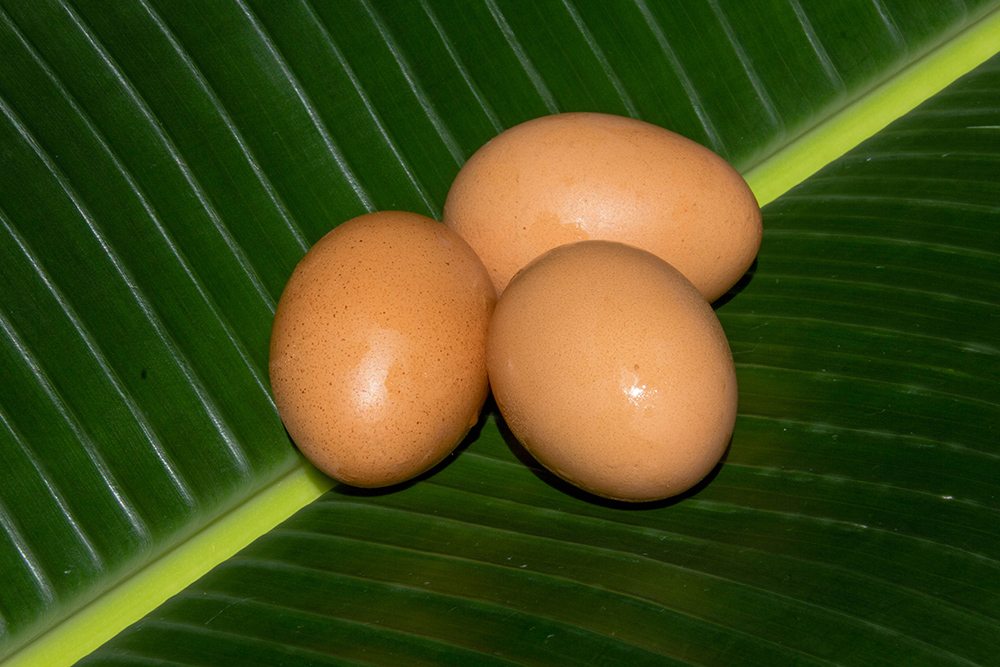
Egg
We have been eating eggs since the dawn of human time.
Jungle fowl was properly domesticated in India and South-east Asia about 7500 BCE. The domestication of the jungle fowls was not because of the meat but because of the eggs.
Chickens were then bought to Egypt and Sumer by 1500 BCE, and in 800 BCE they had spread to Greece. Since 600 BCE chicken have been domesticated in Europe.
A hotel owner and a farmer had a dispute about broken eggs in 1911. This dispute was the reason why Joseph Coyle invented the egg carton. The first cartons in use were made of paper.
Before the egg carton, as we know them today, the egg was transported in the basket, a predecessor to Joseph Coyle´s egg carton was invented by Thomas Peter Bethell in 1907. It was created of frames of interlocking strips of cardboard there were packed in wooden boxes or cardboard so it was easier to transport the eggs.
When you buy eggs at the local markets in Thailand today, they often come in small plastic bags with newspaper between the eggs, so you can say we back to before 1911.
The nutrient fact, below, is based on 100 gram of raw whole raw fresh Egg.
Vitamins
Vitamin C, total ascorbic acid mg 0 0
Thiamin mg 0.04 0.02
Riboflavin mg 0.457 0.228
Niacin mg 0.075 0.038
Vitamin B-6 mg 0.17 0.085
Folate, DFE µg 47 24
Vitamin B-12 µg 0.89 0.44
Vitamin A, RAE µg 160 80
Vitamin A, IU IU 540 270
Vitamin E (alpha-tocopherol) mg 1.05 0.52
Vitamin D (D2 + D3) µg 2 1
Vitamin D IU 82 41
Vitamin K (phylloquinone) µg 0.3 0.2
Lipids
Fatty acids, total saturated g 3.126 1.563
Fatty acids, total monounsaturated g 3.658 1.829
Fatty acids, total polyunsaturated g 1.911 0.956
Fatty acids, total trans g 0.038 0.019
Cholesterol mg 372 186
Proximates
Water g 76.15 38.08
Energy kcal 143 72
Protein g 12.56 6.28
Total lipid (fat) g 9.51 4.76
Carbohydrate, by difference g 0.72 0.36
Fiber, total dietary g 0 0
Sugars, total g 0.37 0.18
Minerals
Calcium, Ca mg 56
Iron, Fe mg 1.75
Magnesium, Mg mg 12
Phosphorus, P mg 198
Potassium, K mg 138
Sodium, Na mg 142
Zinc, Zn mg 1.29