Pork
Pork is the most consumed meat worldwide.
A wild pig-like animal dates back more than 40 million years. There have been found evidence that pigs were domesticated and hold as livestock since 5000 BC in China. In 1500 BC the domesticated pig has spread to Europe.
Pork consumption accounts for about 38% of the total meat consumption worldwide. I think this is a very high number when you consider that many people do not eat pork of religious reasons.
Muslims is the biggest group not eating pork. Muslims alone constitutes 23% of the world population, and they are not the only group who do not eat pork.
It is not my intention to make any political statements about pork or stating any health properties pork meat is supposed to have.
But in my research in pork for this article, I found frightening many websites who warn against eating industry produced pork. They all said that farmers are using a lot drugs and many chemicals when raising pigs commercially today.
Personally, I now try to only eat organically produced pork meat.
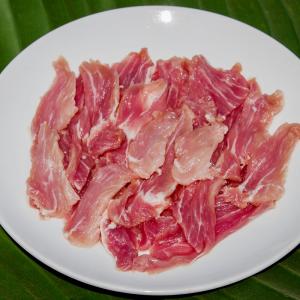
The nutrient fact, below, is based on 100 gram of Pork, fresh, loin, tenderloin, separable lean only, cooked, roasted.
Vitamins
Vitamin C, total ascorbic acid mg 0
Thiamin mg 0.95
Riboflavin mg 0.387
Niacin mg 7.432
Vitamin B-6 mg 0.739
Folate, DFE µg 0
Vitamin B-12 µg 0.57
Vitamin A, RAE µg 0
Vitamin A, IU IU 0
Vitamin E (alpha-tocopherol) mg 0.08
Vitamin D (D2 + D3) µg 0.2
Vitamin D IU 10
Vitamin K (phylloquinone) µg 0
Lipids
Fatty acids, total saturated g 1.198
Fatty acids, total monounsaturated g 1.334
Fatty acids, total polyunsaturated g 0.506
Fatty acids, total trans g 0.033
Cholesterol mg 73
Proximates
Water g 69.45
Energy kcal 143
Protein g 26.17
Total lipid (fat) g 3.51
Carbohydrate, by difference g 0
Fiber, total dietary g 0
Sugars, total g 0
Minerals
Calcium, Ca mg 6
Iron, Fe mg 1.15
Magnesium, Mg mg 29
Phosphorus, P mg 267
Potassium, K mg 421
Sodium, Na mg 57
Zinc, Zn mg 2.42