Thai Basil
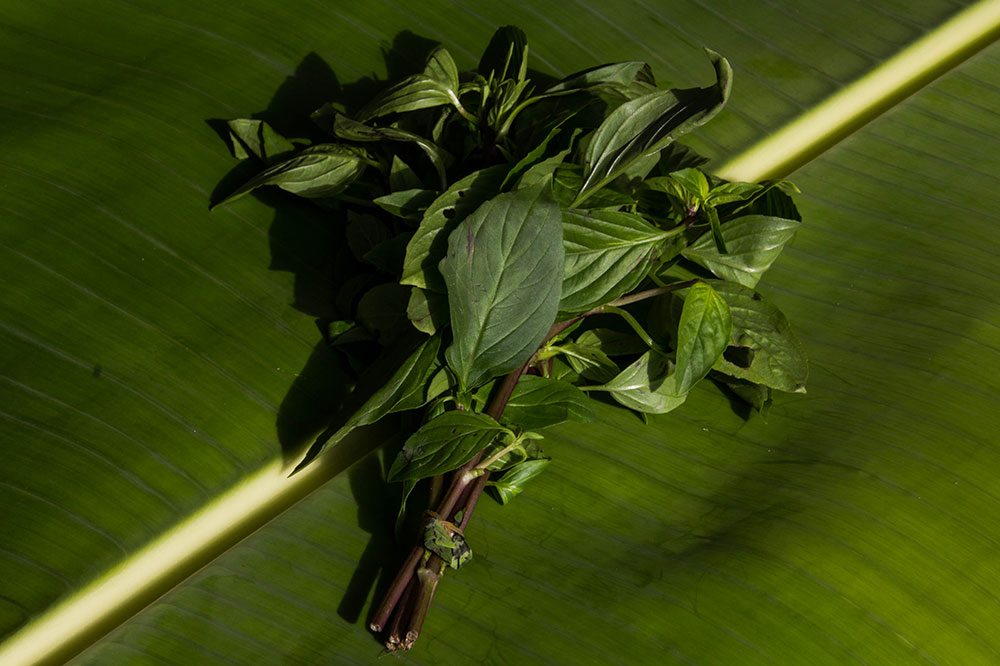
Thai basil is a type of sweet basil.
Basil is grown all over the world and therefore have many different species or you can say different varieties. It is estimated that between 50 and 150 different species of basil, not all are being used for cooking. Thai basil is a hybrid of two of these species.
I’m not an expert when it comes to growing basil. For me, it is a very easy plant to grow. On my farm grows almost everywhere. It started to spread from my outdoor kitchen where there must have been lost some seeds from something basil used for cooking.
There are still growing a lot, around the kitchen, but the plants have also spread to other parts of the farm. Those who grow farthest is now 50 meters from the kitchen.
It’s probably needless to say that basil is one of the herbs I buy, I rely solely on the ones growing wild on the farm
It is a little uncertain where basil originally comes from but there are indications that it comes from India, where it has been cultivated for at least 5000 years.
Thai basil is also used as a remedy in Thai traditional medicine.
The nutrient fact, below, is based on 100 gram of fresh Basil, not the Thai variety.
Vitamins
Vitamin C, total ascorbic acid mg 18
Thiamin mg 0.034
Riboflavin mg 0.076
Niacin mg 0.902
Vitamin B-6 mg 0.155
Folate, DFE µg 68
Vitamin B-12 µg 0
Vitamin A, RAE µg 264
Vitamin A, IU IU 5275
Vitamin E (alpha-tocopherol) mg 0.8
Vitamin D (D2 + D3) µg 0
Vitamin D IU 0
Vitamin K (phylloquinone) µg 414.8
Lipids
Fatty acids, total saturated g 0.041
Fatty acids, total monounsaturated g 0.088
Fatty acids, total polyunsaturated g 0.389
Fatty acids, total trans g 0
Cholesterol mg 0
Proximates
Water g 92.06
Energy kcal 23
Protein g 3.15
Total lipid (fat) g 0.64
Carbohydrate, by difference g 2.65
Fiber, total dietary g 1.6
Sugars, total g 0.3
Minerals
Calcium, Ca mg 177
Iron, Fe mg 3.17
Magnesium, Mg mg 64
Phosphorus, P mg 56
Potassium, K mg 295
Sodium, Na mg 4
Zinc, Zn mg 0.81