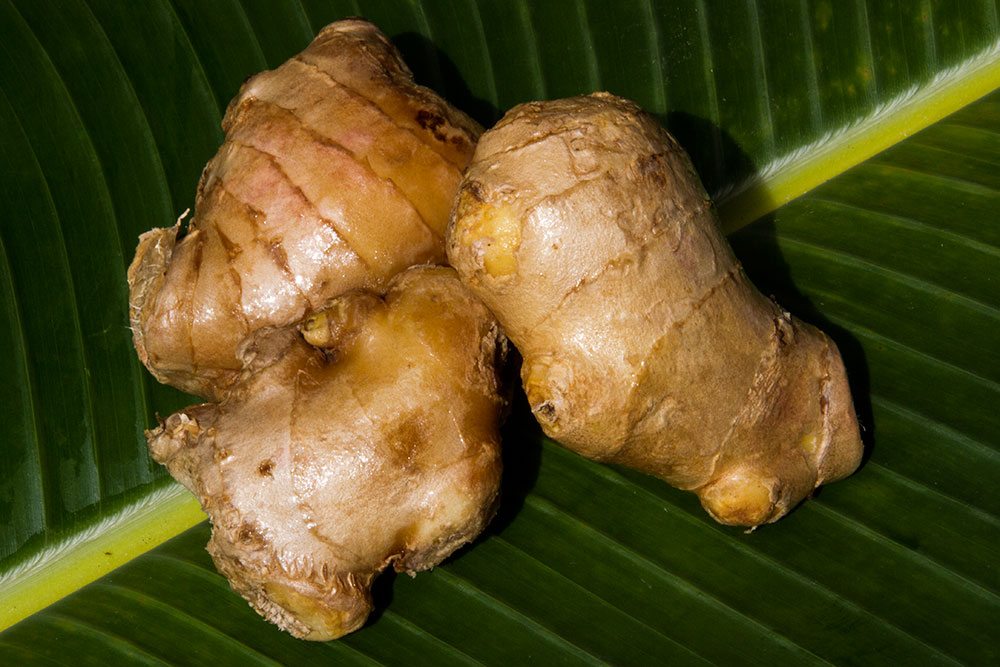
Ginger
Ginger was considered a luxury more than 5000 years ago.
Ginger is native to south-east Asia, more specific in southern China. From there it spread and have been grown has been grown in many other countries. The first time it appears in writing is in the 5th century BC, where Confucius writes he will never be without it when he eats.
Besides being counted as the second most important spice, it is also considered to be a very important constituent in natural medicine worldwide and has been for thousands of years
Ginger is one of the most traded and cultivated spice throughout history. It was the 1. centuries traders who exported it to Rome and Europe. It was a very valued spice in the Roman empire. Unfortunately fell the popularity, when the Roman empire fell.
There are many varieties of ginger grown around the world. But the Cochin ginger from India is by many considered to be one of the best and therefore the most valuable.
The roots are what is used for food and natural medicine. But the flower is beautiful and it is traded a lot in the cut flower business.
Even India is the have the biggest production with 683.000 tons per year, is it still necessary for India to import ginger as India is also is the biggest consumer.
The nutrient fact, below, is based on 100 gram of fresh Ginger root.
Vitamins
Vitamin C, total ascorbic acid mg 5
Thiamin mg 0.025
Riboflavin mg 0.034
Niacin mg 0.75
Vitamin B-6 mg 0.16
Folate, DFE µg 11
Vitamin B-12 µg 0
Vitamin A, RAE µg 0
Vitamin A, IU IU 0
Vitamin E (alpha-tocopherol) mg 0.26
Vitamin D (D2 + D3) µg 0
Vitamin D IU 0
Vitamin K (phylloquinone) µg 0.1
Lipids
Fatty acids, total saturated g 0.203
Fatty acids, total monounsaturated g 0.154
Fatty acids, total polyunsaturated g 0.154
Fatty acids, total trans g 0
Cholesterol mg 0
Proximates
Water g 78.89
Energy kcal 80
Protein g 1.82
Total lipid (fat) g 0.75
Carbohydrate, by difference g 17.77
Fiber, total dietary g 2
Sugars, total g 1.7
Minerals
Calcium, Ca mg 16
Iron, Fe mg 0.6
Magnesium, Mg mg 43
Phosphorus, P mg 34
Potassium, K mg 415
Sodium, Na mg 13
Zinc, Zn mg 0.34